Contact Form
Saturday, 7 February 2015
Wednesday, 19 November 2014
Elements of Dance
Dancing is a expression of feelings. it is a rhythmic physical movement tuned or timed to a melody. dancing is both an art and a form of recreation
Dance consists of a succession or arrangement of steps and rhythmic movements to a musical and or rhythmic accompaniment
1. as entertainment
2. as part of rituals
3. as an expression of inner thoughts
the ancient times dancing and singing and playing instrument went to gather as a part of ritual ceremonies. Mating and courtship dances serve as a means of communication
The primitive way of dancing started from stamping of foot on the ground
all activities were associated with dance like war dance, planting and harvest and fishing, courtship and wedding dance
Reasons why dance occur
1. religious reason - dance is treated like a prayer for good harvest and fertility of crops
2. recreational reason - dancing for fun and it releases energy and expresses joy
The elements of dance
1. content (theme) - provides a unifying element to the movement of the dancers. It attempts to tell a story and evoke
emotions like acting drama literature, instead of using dialogues body and movement are shown to achieve intention
2. movement - the basic of element of dance. it means by which the dancers can externalize an inner state or condition \ then communicate with an audience.
movement can be slow or fast they may be accelerated or retard
movements of dancers occurs in space and the path of dancers make pattern of line which could straight of curve
3. music - music is the real partner to dance. dance without music has no life at all it s an aid to the rhythmic movement
and goes the strong physical and emotional outcome, music and dance has similar role to play. it may function
as background to set the mood
4. spectacle - the sequence of movement and music creates a kind of spell in audience. the scenery and costumes add to the
creation of the spell. A background or setting is provided by having decorations at the stage that is suitable to the dance
dance has many forms primitive, ritual, folkdance, balletm modern dance, and others
primitive - communicates to the supernatural powers
ritual - reaches mytical condition
folk dance - reflect recreational activities of a place
ballet - acts a story or idea expressed
modern dance - expresses natural movement
Wednesday, 29 October 2014
Tinikling History
Tinikling
The tinikling dance is one of the most popular and well-known of traditional Philippine dances. The tinikling is a pre-Spanish dance from the Philippines that involves two people beating, tapping, and sliding bamboo poles on the ground and against each other in coordination with one or more dancers who step over and in between the poles in a dance. The name is a reference to birds locally known as tikling, which can be any of a number of rail species; the term tinikling literally means "tikling-like." The dance originated in Leyte among the Visayan islands in the central Philippines as an imitation of the tikling bird dodging bamboo traps set by rice farmers. The dance imitates the movement of the tikling birds as they walk between grass stems, run over tree branches, or dodge bamboo traps set by rice farmers. Dancers imitate the tikling bird's legendary grace and speed by skillfully maneuvering between large bamboo poles.
Legend says that Tinikling originated during the time when the Spaniards took over the Philippines. Natives worked on large plantations under the control of the King of Spain. Those who didn't work productively were punished by standing between two bamboo poles.
For this traditional folk dance, females wear a dress called balintawak or patadyong, and males wear a uniform called barong tagalog. The balintawak are colorful dresses with wide arched sleeves and the patadyong is a pineapple fiber blouse paired with checkered skirts. The barong tagalog uniform is usually lightweight long sleeved shirts and worn with red trousers. Dancers wear no footwear while performing.
Tinikling involves five steps; during the first four steps, the dancers dance opposite each other, and during the last step, they start from the same side of the poles.
The bamboo is also used as a percussive instrument as it is banged against the ground (or a piece of wood to make it easier to hold) and each other in a pattern. The bamboo has to be closed hard enough to make a sound, and the dancers must be quick enough to not get their foot (or feet) caught. As the dance continues, the banging of the bamboo becomes faster and harder, the sound of the clashing bamboo and the quickness of feet demonstrated by the dancers thrilling and awing the crowd. In the United States, this dance had been altered into a four-beat rhythm to adjust to popular music. In some cases, it has been used in conjunction with traditional Filipino martial arts to demonstrate fleetness of foot and flow of movement.
Vicente I. De Veyra compiled tinikling music in his book, Mga Ambahan. Today Tinikling is taught throughout the United States. In grades K-12 they use this type of folk dance as an aerobic exercise for physical education classes to help expand physical movements such as hand coordination, foot speed, and also their rhythm. Tinikling is commonly performed on special occasions such as the Filipino Independence Day Independence Day (Philippines). This traditional dance is a celebration of Filipino culture and Filipino pride.
Guide Questions:
1. What is Tinikling?
2. How does Tinikling oringinated?
3. What are the costumes used in dancing the Tinikling?
4. Where did the Tinikling traditional dance come from?
5. What is the basic equipment in dancing the Tinikling?
From Wikipedia, the free encyclopedia
image from: www.philamfood.com
Sunday, 28 September 2014
Unarmed and Weapon Self-defense "The Philippine's Stick Fighting (ARNIS)
Modern Arnis is the system of Filipino martial arts founded by Remy Presas as a self-defense system. His goal was to create an injury-free training method as well as an effective self-defense system in order to preserve the older Arnis systems. The term Modern Arniswas used by Remy Presas' younger brother Ernesto Presas to describe his style of Filipino martial arts; since 1999 Ernesto Presas has called his system Kombatan. It is derived principally from the traditional Presas family style of the Bolo (machete) and the stick-dueling art of Balintawak Eskrima, with influences from other Filipino and Japanese martial arts.
One of the characteristics of Filipino martial arts is the use of weapons from the very beginning of training and Modern Arnis is no exception. The primary weapon is the rattan stick, called a cane or baston (baton), which varies in size, but is usually about 28 inches (71 cm) in length. Both single and double stick techniques are taught, with an emphasis on the former; unarmed defenses against the stick and against bladed weapons (which the stick is sometimes taken to represent) are a part of the curriculum.
Training covers empty-hand self-defense (striking, locking, throwing, etc.) as well as the trademark single and double stick techniques of the Filipino martial arts. Other aspects of the art include espada y daga (sword and dagger fighting), sinawali (double stick weaving patterns), and tapi-tapi (locking drills with the stick). In addition to partner drills, Modern Arnis includes the use of anyo (kata), solo forms both with and without the stick. Emphasis is placed on fitting the art in with a student's previous training ("the art within your art"), smoothly reacting to changing situations in the fight ("the flow"), and countering the opponent's attempt to counter strikes directed at him ("tapi-tapi"). Practitioners are called arnisadors or Modern Arnis players.
Equipment used in Arnis
the cane or club is the standard equipment used in eskrima. The cane should be made of rattan or liana, dried, rounded at both ends. The length of the cane shall be 12 to 36 inches and about three quarters to inch in diameter. The standard length of arnis is 28 inches.
http://en.wikipedia.org/wiki/Modern_Arnis#Training
Wednesday, 17 September 2014
Badminton History, Governing bodies, Scoring and Service for doubles and singles
THE NET
The full width of the court is 6.1 meters (20 ft), and in singles, this width is reduced to 5.18 meters (17 ft).
The full length of the court is 13.4 meters (44 ft).
The service courts are marked by a center line dividing the width of the court, by a short service line at a distance of 1.98 meters (6 ft 6 inch) from the net, and by the outer side and back boundaries.
In doubles, the service court is also marked by a long service line, which is 0.76 meters (2 ft 6 inches) from the back boundary.
Badminton strokes
Different Badminton Strokes:
1. Serve - underhand stoke to start gameplay
2. Overhand Clear - overhand stroke driving the birdie high
and deep into the opponent's court
3. Underhand Clear - underhand stroke driving the birdie high
and deep into the opponent's court
4. Drop - a short shot in which just clears the net, and falls
close to the net in the opponent's court.
5. Smash - an overhead stroke in which the birdie travels at a downward angle (spike).
HISTORY OF BADMINTON
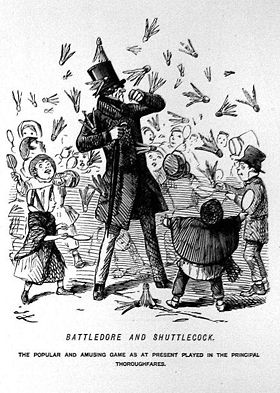
Badminton has its origins in ancient civilizations in Europe and Asia. The ancient game is known as battledore (bat or paddle) and shuttlecock probably originated more than 2000 years ago.
In the 1600s battledore and shuttlecock was an upper-class pastime in England and many European countries. Battledore and shuttlecock were simply two people hitting a shuttlecock backward and forwards with a simple bat as many times as they could without allowing it to hit the ground.
Modern badminton can be traced to mid-19th century British India. It was created by British military officers stationed there. A net was added to the traditional English game of battledore and shuttlecock. As it was popular in the British garrison town of Poona, the game came to be known as "Poona" or "Poonai" Initially, woolen balls were preferred by the upper classes in windy or wet conditions, but ultimately shuttlecocks took over the role of a "ball." This game was taken by retired officers who got back to England. It was introduced as a game for the guests of the Duke of Beaufort at his stately home 'Badminton' in Gloucestershire, England where it became popular. Hence, the origin of the name "Badminton."
http://www.teamusa.org/USA-Badminton/USAB/History/Brief-History-of-Badminton
Duke of Beaufort is a title in the Peerage of England. It was created by Charles II in 1682 for Henry Somerset, 3rd Marquess of Worcester, a descendant of Charles Somerset, 1st Earl of Worcester, legitimized son of Henry Beaufort, 3rd Duke of Somerset, a Lancastrian leader in the Wars of the Roses. The name Beaufort refers to a castle in Champagne, France (now Montmorency-Beaufort). It is the only current dukedom to take its name from a place outside the British Isles.
Governing bodies
The Badminton World Federation (BWF) is the internationally recognized governing body of the sport. The BWF headquarters are currently located in Kuala Lumpur, Malaysia.
Five regional confederations are associated with the IBF:
• Asia: Badminton Asia Confederation (BAC)
• Africa: Africa Badminton Federation (ABF)
• Americas: Badminton Pan Am (North America and South America belong to the same confederation; BPA)
• Europe: Badminton Europe (BE)
• Oceania: Badminton Oceania (BO)
• Africa: Africa Badminton Federation (ABF)
• Americas: Badminton Pan Am (North America and South America belong to the same confederation; BPA)
• Europe: Badminton Europe (BE)
• Oceania: Badminton Oceania (BO)
The Laws of Badminton and Competition Regulations in the BWF Statutes provide the
detail on every aspect of the game of badminton.
Scoring System
- A match consists
of the best of 3 games
- of 21 points.
- Every time there
is a serve – there is a point scored.
- The side winning
a rally adds a point to its score.
- At 20 all, the
side which gains a 2 point lead first, wins that game.
- At 29 all, the
side scoring the 30th point, wins that game.
- The side winning
a game serves first in the next game.
Interval and Change of Ends
- When the leading
score reaches 11 points, players have a 60 second interval.
- A 2 minute
interval between each game is allowed.
- In the third
game, players change ends when the leading score reaches 11 points.
Singles
- At the beginning
of the game (0-0) and when the server’s score is even, the server
serves from the right service court. When the server’s score is odd, the
server serves from the left service court.
- If the server
wins a rally, the server scores a point and then serves again from the
alternate service court.
- If the receiver
wins a rally, the receiver scores a point and becomes the new server. They
serve from the appropriate service court – left if their score is odd, and
right if it is even.
Doubles
- A side has only
one ‘service’.
- The service
passes consecutively to the players as shown in the diagram.
- At the beginning
of the game and when the score is even, the server serves from the right
service court. When it is odd, the server serves from the left court.
- If the serving
side wins a rally, the serving side scores a point and the same server
serves again from the alternate service court.
- If the receiving
side wins a rally, the receiving side scores a point. The receiving side
becomes the new serving side.
- The players do
not change their respective service courts until they win a point when
their side is serving.
If players commit an error in the service court, the error is
corrected when the mistake is discovered.
In a doubles match between A & B against C & D. A
& B won the toss and decided to serve. A to serve to C. A shall be the
initial server while C shall be the initial receiver.
Every player that does
not follow rules or will likely show unruly behavior will be terminated from
the game as default and opposing team wins the game with or without due notice.
|
Scenario
Score
Service From
Server
Winner
|
|
|
Love All
|
Right Service Court because the score of the serving side is
even.
|
A serves to C. A and C are the initial server and receiver.
|
A & B
|
![]() |
|
A & B win a point. A & B will change service courts. A
serves again from Left service court. C & D will stay in the same service
courts.
|
1-0
|
Left Service Court because the score of the serving side is
odd.
|
A serves to D.
|
C & D
|
![]() |
|
C & D win a point and also right to serve. Nobody will
change their respective service courts.
|
1-1
|
Left Service Court because the score of the serving side is
odd.
|
D serves to A.
|
A & B
|
![]() |
|
A & B win a point and also right to serve. Nobody will
change their respective service courts.
|
2-1
|
Right Service Court because the score of the serving side is
even.
|
B serves to C.
|
C & D
|
![]() |
|
C & D win a point and also right to serve. Nobody will
change their respective service courts.
|
2-2
|
Right Service Court because the score of the serving side is
even.
|
C serves to B.
|
C & D
|
![]() |
|
C & D win a point. C & D will change service courts. C
serves from Left service court. A & B will stay in the same service courts.
|
3-2
|
Left Service Court because the score of the serving side is
odd.
|
C serves to A.
|
A & B
|
![]() |
|
A & B win a point and also right to serve. Nobody will
change their respective service courts.
|
3-3
|
Left Service Court because the score of the serving side is
odd.
|
A serves to C.
|
A & B
|
![]() |
|
A & B win a point. A & B will change service courts. A
serves again from Right service court. C & D will stay in the same
service courts.
|
4-3
|
Right Service Court because the score of the serving side is
even.
|
A serves to D.
|
C & D
|
![]() |
Note that this means:
- As in singles,
the order of server depends on whether the score is odd or even.
- The service
court is changed by the servicing side only when a point is scored. In all
other cases, the players continue to stay in their respective service
court from where they played the previous rally. This guarantees an
alternate server.
SOURCES:
Badminton World Federation
http://en.wikipedia.org/wiki/Badminton
http://www.edbsa.com/govering_bodies.html
Subscribe to:
Posts (Atom)


